


Dante: Transforming AV Connectivity
Until not too long back, professional audio and video systems were built around dedicated cables, physical patch panels and point-to-point connections. Adding a new device often meant adding more cables. Large meeting spaces became a challenge because distance limitations inherent to cables. Changing the way signals moved through a system could involve physically reconfiguring the entire infrastructure.
Then came Dante. Created by Aidan Williams and David Myers– co-founders of Audinate
Dante changed the way the professional AV industry imagined connectivity by bringing audio and video onto standard IP networks. What began as a technology for moving media over Ethernet has evolved into a powerful networked AV ecosystem connecting thousands of devices across almost all collaboration applications.
It is pertinent to say that Dante changed the mindset, nay, the very essence of the AV industry.
So, What Exactly Is Dante?
At its core, Dante is a network platform for AV connectivity designed to make professional AV systems easier to connect, configure and manage.
Instead of requiring dedicated cabling for every audio or video signal, Dante allows compatible AV devices to communicate over standard Ethernet networks.
The dramatic result was that this created a simpler approach to connecting devices and spaces – with a single network connection that could carry media and control across an entireenterprise network infrastructure.
This is what makes Dante particularly powerful: it brings the flexibility and scalability of IT networking into the world of professional AV.
How Does Dante Work?
Traditional AV infrastructure often relies on dedicated connections between individual devices. A microphone connects to a mixer. A mixer connects to an amplifier. A camera connects to a switcher. Each signal may require its own cable and physical routing.
Dante takes a different approach.
It uses standard IP networking and Ethernet infrastructure to transport audio and video, allowing compatible devices to communicate across the network. That routing can then be configured through software rather than by physically connecting individual cables.
A simple change but with tremendous implications. The shackles of traditional point-to-point AV cabling suddenly disappeared.
Devices can be added, moved or reconfigured without redesigning the entire physical AV infrastructure. Signals can travel across a facility – and, with the appropriate network architecture, across much larger environments.
So Where Is Dante Used?
The versatility of Dante ecosystems means that it can support very different AV environments.
Enterprise
Dante enables audio and video devices to become part of a common networked infrastructure, making it easier to connect meeting spaces and collaboration environments. With Dante, it is easy to deploy and manage, mics, cameras, processors etc.
And the impact? Less dependence on point-to-point cabling, greater flexibility as spaces and technology requirements evolve, easier management and very importantly, merging the IT and AV teams into one cohesive unit.
Broadcast
Live broadcast set ups demand reliability, signal quality and flexibility.
Signals may be captured in one location, routed through multiple stages of production and finally delivered to completely different space.
Dante’s network-based architecture provides broadcasters with the flexibility to route signals through the network rather than being limited by fixed physical connections.
How Did Dante Change the AV Market?
Perhaps Dante’s biggest impact is not a particular feature, but a fundamental change in the architecture of professional AV systems.
Before AV-over-IP became mainstream, professional AV infrastructure was largely hardware-centric.
Dante helped change that model.
By moving AV signals onto standard Ethernet infrastructure, Dante helped transform professional AV from a collection of physically interconnected devices into a networked ecosystem of hardware and software.
And software became the control layer. This is perhaps the most important conceptual shift. A signal can be routed from one device to another without physically moving a cable. This changes the very fundamentals
Result – AV devices became intelligent endpoints on that network.
More Than Just AV Over IP
Dante’s significance goes beyond replacing AV cables with Ethernet cables. It represents the convergence of professional AV and enterprise IT.
The AV industry began adopting concepts that had long been familiar to IT professionals: networks, switches, software configuration, scalability, centralized management and standardized infrastructure.
This convergence has fundamentally changed how AV systems are designed.
The Future Is Networked
The growth of collaboration, hybrid working, distributed campuses, digital learning, streaming and sophisticated production environments continues to increase the demand for flexible AV infrastructure.
Dante has played a major role in enabling that transition
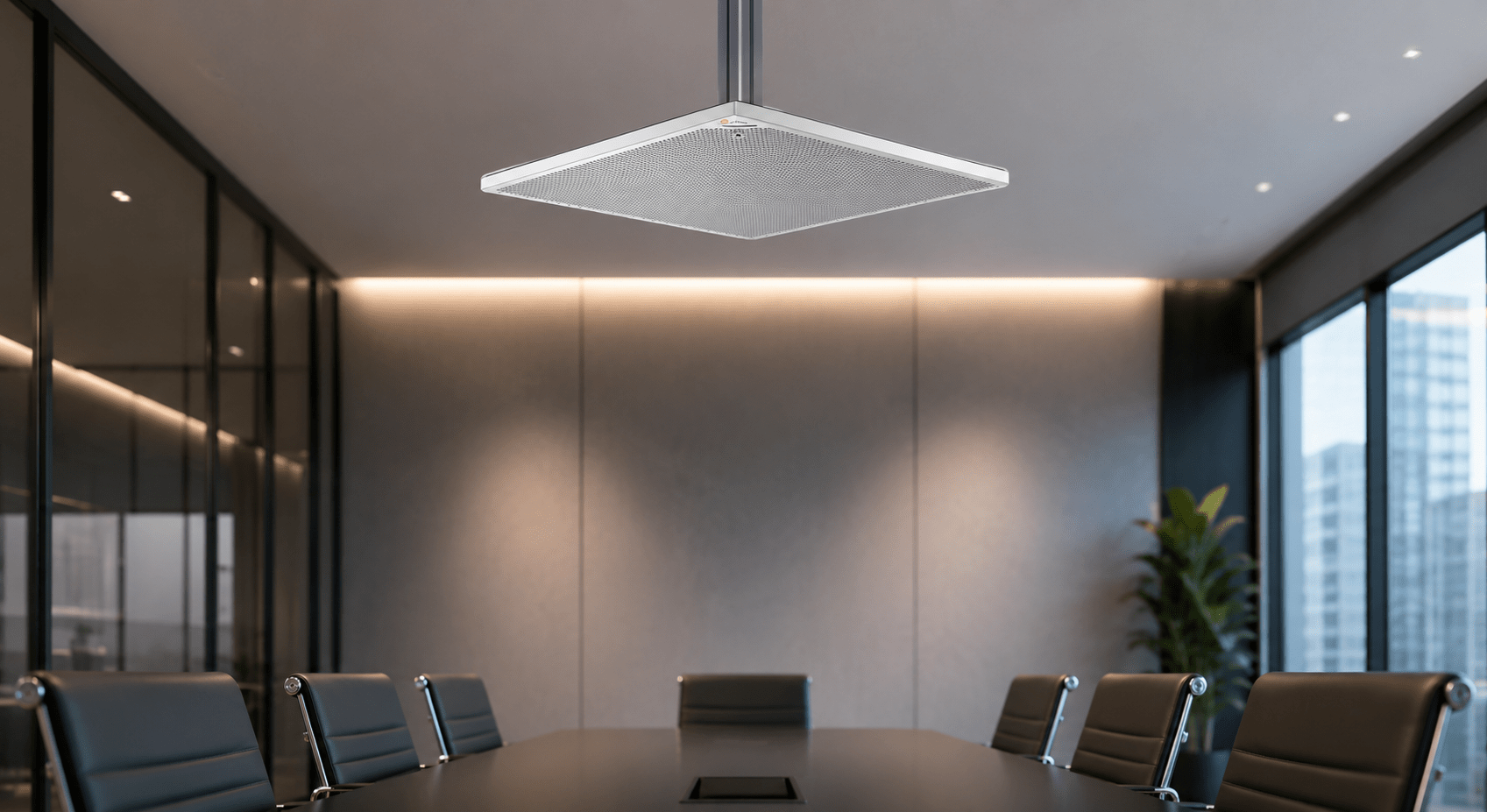
At A&T, we recognize the real importance of Dante and are adapting to meet market demands. With the Air CSD, a unique ceiling tile speakerphone, we have entered the Dante space. And there is a whole lot more on the horizon.
A&T is creating an entire Dante ecosystem that will revolutionize the way enterprises, govt. entities, hospitals, and houses of worship think of collaboration. Watch this space for more announcements soon.